
THE GOVERNANCE DIVIDEND
How Carmel, Indiana Proves That High-Quality Governance Is Cheap When a Community Is Coherent

A Case Study for the Free Cities and Private Governance Movements
Introduction: What does good governance actually cost?
Most people assume that good governance is expensive. That it demands large bureaucracies, heavy tax burdens, and a government apparatus that grows in perpetuity. Carmel, Indiana suggests they are wrong. What the Carmel experience shows instead is that when a community shares basic norms, when the physical environment is well designed, and when leadership makes deliberate choices about what to build, governance gets cheap. Surprisingly cheap.
Carmel runs a city of over 105,000 people on a general fund budget of about $144 million, which works out to roughly $1,371 per resident.[1] The average American city of comparable size spends between $2,500 and $4,000 per capita.[2] Carmel regularly shows up on best-places-to-live lists from Money Magazine, Niche, and U.S. News at a fraction of what peer cities spend on governance.[3] That gap is not luck. It follows from specific design decisions, from the kind of people those decisions attract, and from an uncomfortable truth that most governments avoid: the distribution of governance problems follows a power law.
This paper uses Carmel as a proof of concept for a bigger argument, one that is picking up speed through the free cities, charter cities, and private governance movements.[4] The argument: governance is a service. Like any service, it can be delivered well or badly. When you deliver it inside a coherent community built on sound urban principles, costs fall and quality rises.
Part I: The Carmel story
From bedroom community to best place to live
Carmel sits just north of Indianapolis in Hamilton County. For most of the twentieth century, it was a quiet bedroom community, the kind of place people slept before commuting to their real lives in the city.[5] In 1990 it had about 25,000 residents, no real downtown, no cultural identity, and no ambition beyond being a decent place to mow a lawn.
That changed when Jim Brainard won the mayor’s office in 1996. A Republican attorney who had spent time traveling in Europe, Brainard had seen what actual cities looked like: walkable streets, mixed use development, public squares where people gathered, infrastructure built for humans rather than just cars.[6] He came home and looked at Carmel as raw material.
What followed was a twenty-eight year transformation that has few parallels in American municipal history.[7] Carmel grew from 25,000 to over 100,000 residents. But the real accomplishment was not the growth itself. It was how the city grew. Instead of the usual American pattern of subdivisions, arterial roads, and strip malls, Brainard pursued an urban placemaking agenda that would have raised eyebrows in Portland or Brooklyn, let alone in a conservative Indiana suburb.
The Brainard vision: building a city, not a suburb
Brainard grasped something that most suburban mayors miss. There is a real difference between a city and a suburb, and the distinction matters for budgets, for quality of life, and for whether a place can sustain itself over the long run. Suburbs depend on nearby cities for culture, jobs, and identity while giving back relatively little. A real city generates its own economic gravity, its own culture, its own reasons to exist.
Turning Carmel from a suburb into a city meant pursuing several strategies at once, and sticking with them for decades:
Brainard built a continuous walkable district centered on a former railroad corridor turned greenway, connecting the Arts and Design District, Midtown, and Carmel City Center.[8] This was a serious undertaking. It meant rezoning, buying land, assembling public-private partnerships, and maintaining a sustained commitment to mixed use, human-scale development over multiple election cycles.
Then there are the roundabouts. Carmel has over 150 of them, more than any other American city.[9] They were not an aesthetic flourish. A roundabout costs about $250,000 less to build than a signalized intersection and saves over $5,000 a year in electricity alone.[10] But the safety numbers tell the real story. In 1996, Carmel had 30,000 residents and 217 traffic accidents. By 2019, 100,000 residents and fewer than 200 accidents. The population tripled; the accident count went down.
While Indianapolis Mayor William Hudnut famously used sports as an economic development tool, Brainard bet on the arts. Carmel built the Center for the Performing Arts and established the Arts and Design District, now home to over 200 art and design businesses including the Indiana Design Center. Americans for the Arts estimated that Carmel’s arts venues generated $42.7 million in economic impact in 2022.[11]
The park system grew from 41 acres to over 750. Well-designed parks in walkable communities tend to police themselves through constant use, which means the maintenance cost per acre stays low even as the system expands.[12]
The debt question
None of this was free. By 2019, Carmel carried approximately $1.3 billion in outstanding debt, the third highest of any Indiana city and about $14,145 per resident.[13] Critics raised alarms, and Standard and Poor’s dropped the city’s rating from AA+ to AA.[14]
But there is a distinction that matters here: investment debt versus consumption debt. Carmel’s borrowing went into infrastructure, public spaces, and commercial development that directly grew the taxable property base. That base increased sixfold during Brainard’s tenure, from roughly $2 billion to over $12 billion.[15] The city was not borrowing to plug budget holes. It was using capital to build assets that throw off revenue. An independent review by Reedy Financial Group in 2024 concluded that the debt load was reasonable and the repayment plans were sound.[16]
And here is the number that puts the debt controversy in perspective: Carmel’s property tax rate is 78 cents per $100 of assessed value, the fifth lowest in Indiana. Because commercial development carries a large share of the tax load, the average homeowner contributes less than $10 per year toward the city’s debt service. Intelligent investment in urban form, as opposed to endless suburban sprawl, generates returns that dwarf the cost of borrowing.
Part II: The budget case for coherent governance
What $144 million buys
Carmel’s 2026 general fund budget of approximately $144 million covers the full range of municipal services for 105,000 people.[17] At roughly $1,371 per capita, here is what it covers:
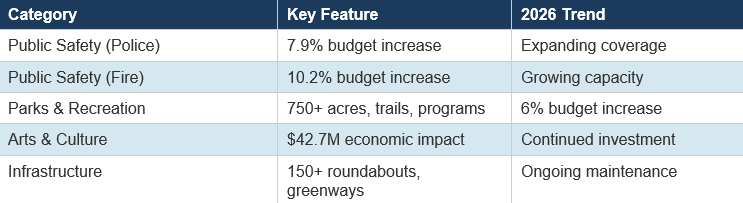
The budget faces new headwinds. Indiana’s Senate Enrolled Act 1, designed to lower property taxes statewide, means Carmel expects to collect $3.8 million less in tax revenue in 2026 than previously projected.[18] Mayor Sue Finkam, who succeeded Brainard in 2024, has responded with staff reductions and accelerated debt paydown while keeping investment in core services. Most city employees get a 3 percent cost of living increase; the mayor and senior leadership took no raises.
The per capita comparison
The numbers look even more striking in context. The average American municipality spends between $2,500 and $4,000 per capita on general fund operations.[19] Large cities spend much more. New York exceeds $12,000 per capita.[20] San Francisco exceeds $15,000.[21] These cities face different problems, granted. But even with generous adjustments for scale and complexity, the gap between Carmel and everywhere else is hard to explain away.
Carmel delivers police, fire, parks, cultural programming, infrastructure maintenance, and full municipal services for $1,371 per person, and keeps showing up on national best-places-to-live lists while doing it.[22]
So what makes this possible?
Part III: The power law of governance problems
Why most problems come from a small fraction of people
The Pareto Principle, the familiar 80/20 rule, says roughly 80 percent of effects come from 20 percent of causes. In governance, the ratio is often more lopsided than that. This is not ideology; it is one of the most consistently replicated findings in criminology, public administration, and urban studies.
Consider crime. In Marvin Wolfgang’s Philadelphia cohort study, 5 percent of offenders committed more than half of all crimes.[23] In Washington, D.C., about 60 to 70 percent of gun violence traces to roughly 500 individuals in a city of 700,000.[24] A 2025 study in Behavioral Sciences and the Law found that the top 20 percent of inmates were responsible for about 90 percent of prison rule violations.[25]
The pattern extends to geography. David Weisburd’s work at George Mason University shows that crime clusters at specific addresses and street segments. A small number of hot spots produce the vast majority of calls for service.[26]
Emergency services, code enforcement, and social services follow the same distribution. A handful of properties in any municipality can consume more public resources than whole neighborhoods. The Strong Towns movement has documented this pattern extensively.[27]
What this means for community composition
This is where the argument gets uncomfortable. If somewhere between 5 and 10 percent of a population generates 80 to 90 percent of governance costs, then the composition of a community is the biggest factor in determining how expensive governance needs to be. This has nothing to do with race or ethnicity in any crude sense. It is about behavioral coherence: whether residents broadly share norms around property maintenance, public conduct, and participation in civic life.
Carmel is a behaviorally coherent community. Median household income is about $134,602, nearly two and a half times the national figure.[28] Residents are overwhelmingly employed, educated, and invested in where they live. The city did not get this way by putting up barriers. It got this way by building something specific and good, and letting people self-select into it.
The result is a compressed power law curve. When very few residents fall into the heavy tail of the problem distribution, governance costs collapse. Fewer police are needed because there is less crime. Fewer code enforcement officers because people maintain their properties. Fewer social workers because fewer people are in crisis. The whole apparatus of government that exists to manage the consequences of dysfunction shrinks.
Income alone does not explain it
High income by itself does not produce low governance costs. Plenty of wealthy areas are expensive to govern because of NIMBYism, political fragmentation, or poor physical design. What matters is the alignment of residents around shared norms, combined with a physical environment that reinforces those norms.
Carmel achieves that alignment through design. By building a walkable, mixed use city with good public spaces, it attracts people who want community life. By investing in arts and culture, it creates shared experiences and social capital.[29] By maintaining good schools and safe streets, it retains families who have choices and could easily live elsewhere. The physical city reinforces the social cohesion that keeps governance cheap, and the cheap governance makes the physical city affordable. Each side feeds the other.
Part IV: Building a city, not a suburb
The fiscal math of sprawl
The fiscal case against suburban sprawl has been made before, but it still does not get the attention it deserves.[30]
Cities in the most sprawling quintile spend an average of $750 per capita on public infrastructure each year, 50 percent more than the $500 per capita spent by the most compact cities.[31] For hard infrastructure like water, sewers, and roads, the lifecycle cost difference is even more extreme. Sprawl can cost up to ten times more per household than compact development.
Each suburban home generates a net fiscal loss of $1,500 to $2,500 per year for local governments.[32] Tax revenue from a typical subdivision does not cover the roads, utilities, and services it requires. The shortfall gets subsidized by commercial districts and denser neighborhoods, a cross-subsidy that is invisible to most taxpayers but slowly wrecks municipal balance sheets.
Sprawl also increases the cost of fire protection, police coverage, snow removal, school busing, and every other distance-dependent service by 10 to 40 percent.[33] Covering more ground for fewer people is simply more expensive.
The New Climate Economy puts the total cost of sprawl in the United States at approximately $1 trillion annually when all externalities are included: infrastructure, transportation, environmental damage, health, and lost productivity.[34]
How Carmel’s design cuts costs
Each of Carmel’s 150-plus roundabouts saves thousands per year in electricity, signal maintenance, and accident response.[35] Because roundabouts reduce serious accidents by 72 to 80 percent, they also cut the emergency response, hospitalization, and litigation costs that follow intersection crashes.[36] Multiply those savings across 150 intersections and you have a meaningful chunk of a municipal budget.
Carmel’s walkable districts produce what Jane Jacobs called “eyes on the street,” the natural surveillance that happens when buildings face sidewalks and people are out walking at all hours.[37] Crime prevention through environmental design is not a budget line in Carmel; it is baked into the streetscape.
Mixed use development broadens the tax base. When commercial, residential, and cultural uses share the same walkable districts, commercial tax revenue flows from areas that might otherwise be purely residential. That is why the average Carmel homeowner pays less than $10 per year toward debt service despite the city carrying $1.3 billion in bonds.[38]
And compact infrastructure is just cheaper to maintain. Shorter road networks, denser utility connections, concentrated service areas. When you are not maintaining miles of cul-de-sacs serving a few dozen homes, the public works budget stretches further.[39]
The architecture of community
The case for urban design goes beyond fiscal efficiency, though. The physical form of a place shapes the relationships people form, which in turn shapes what governance costs. Suburban sprawl isolates people. They drive from garage to destination and back, rarely running into neighbors. That isolation erodes social capital and shifts the burden of maintaining order from the community to formal government.[40]
Urban form does the opposite. When people walk to restaurants, bump into neighbors at the farmers market, linger in public squares, and share trails, they build relationships. They develop shared stakes. Ray Oldenburg called the informal gathering spots that enable this “third places”: neither home nor work, but the cafes, parks, and public spaces where civic life actually happens.[41] This informal social infrastructure is what allows Carmel to run at $1,371 per capita. The community itself handles a large share of what formal government would otherwise have to manage.
That insight, that the physical design of a community is inseparable from how much it costs to govern, is underappreciated in policy circles. And it is central to the question investors and city builders care about most: can you replicate this?
