
The Speed Trap
The emerging small modular reactor industry is captivated by speed. But history suggests the real winners will be the companies that deliver the lowest through-life cost of energy.

Speed has become the defining narrative of the nuclear SMR startup world, and for good reason. Several companies, among them Aalo Atomics and Valar Atomics, have hit impressive milestones that would have seemed unrealistic just a few years ago. The industry badly needed this proof of momentum. But as these early milestones accumulate, a second question comes into focus: speed toward what?
The urgency is understandable, and a lot of it is well-placed. Nuclear energy has spent decades mired in delays, cost overruns, and abandoned projects. After the cancellation of NuScale’s Carbon Free Power Project and a string of similar setbacks, the industry badly needs proof that new nuclear can actually get built. And speed is an important component to the equation as it is a genuine path to lower costs. Faster construction timelines reduce financing costs, earlier operational experience accelerates learning curves, and factory-built modularity creates real economies of scale. Speed, done right, is one of the most powerful levers the industry has.
But here is the question that the speed narrative sometimes glosses over: speed toward what?
The Only Metric That Matters
If we step back from the startup race and ask what energy buyers actually need, the answer is remarkably simple: reliable electricity at the lowest possible cost over the life of the asset. Not the cheapest reactor to build. Not the fastest to deploy. The lowest through-life cost, which includes construction, fuel, operations, maintenance, decommissioning, and everything in between across decades of service.
Speed to market matters enormously insofar as it contributes to this goal. A reactor that gets built quickly but costs more per megawatt-hour over a 40-year operating life is not, in any meaningful sense, a better product. It is a faster one. Those are different things.
This is where a company like NX Atomics enters the picture with a different thesis. Rather than optimizing primarily for speed, NX Atomics is designing a reactor with physics, the fundamental way it produces and sustains energy, engineered to minimize through-life cost. The argument is straightforward: if your reactor design intrinsically requires less fuel, less maintenance, or produces energy more efficiently across its operating lifetime, then you have a structural cost advantage that no amount of first-mover speed can overcome.
It is a bet on economics over momentum. And history suggests it is probably the right bet.
The Cost Floor: Why Speed Can’t Outrun Physics
There is a deeper concept here that deserves attention, because it clarifies why the speed-versus-design debate isn’t just a matter of preference.
Every technology has a structural cost floor, an asymptote that manufacturing learning, scale, and operational efficiency can approach but never break through. Think of it like a physical limit baked into the design itself. You can get closer to that floor by building faster, streamlining supply chains, and accumulating operational experience. All of those things matter, and they are exactly what speed-focused companies are good at. But no amount of manufacturing optimization can push costs below the floor that the underlying technology dictates.
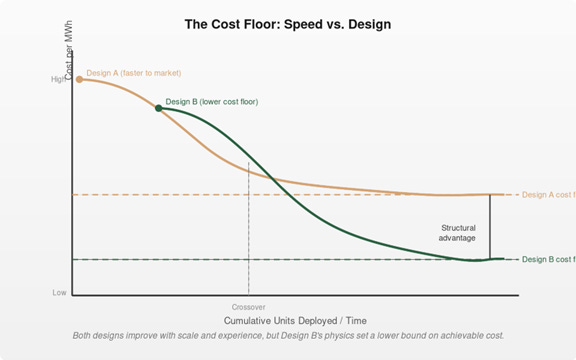
Exhibit 1. Both reactor designs improve with scale and operational experience, but their learning curves converge on different cost floors. Design A reaches market first and drops quickly. Design B enters later but its physics set a structurally lower bound on achievable cost, creating a permanent advantage at maturity.
This is a familiar concept in other domains. Consider solar panels: manufacturers spent decades driving down costs through scale and process improvement, following a remarkably predictable learning curve, but every generation of cell architecture, from polycrystalline to monocrystalline to PERC to heterojunction, had its own asymptote. The breakthroughs that mattered most were not the ones that moved faster along a given curve, but the ones that lowered the asymptote itself, opening up a new, lower cost floor that further manufacturing optimization could then approach.
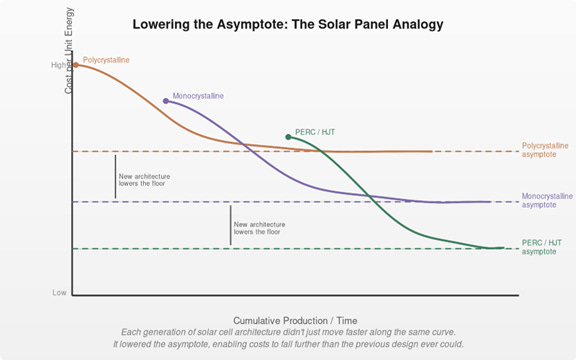
Exhibit 2. Each generation of solar cell architecture had its own cost asymptote. The breakthroughs that mattered most did not move faster along a given learning curve. They lowered the asymptote itself, enabling costs to fall further than the previous design ever could. The same principle applies to nuclear reactor design.
The same logic applies to nuclear reactors. A given reactor design has inherent characteristics, its fuel efficiency, its maintenance requirements, its operational complexity, its decommissioning profile, that establish a cost floor. Speed and manufacturing excellence help you reach that floor faster. But to lower the floor, you need superior physics and smarter manufacturing strategy.
This is what NX Atomics is pursuing. Not a rejection of speed and manufacturing discipline (those remain essential) but a recognition that the most important lever for long-term cost competitiveness is the design itself. NX Atomics supports the industry’s focus on execution speed. But their core thesis is that to move the asymptote, to lower the structural bound on what nuclear energy can cost, you need a fundamentally different reactor design. Speed gets you to the floor, better physics lowers it.
What Other Industries Teach Us
The tension between being first and being best is one of the most studied questions in business strategy, and the evidence is surprisingly clear: first movers win far less often than people assume.
Search engines. AltaVista was the world’s first major search engine. Google arrived years later, studied what worked and what didn’t, and built something fundamentally better. AltaVista is a footnote. Google is a verb.
Social networks. MySpace owned social media before Facebook existed. But Facebook didn’t need to be first. It needed to be better designed and more scalable. By the time it overtook MySpace, the first-mover advantage had evaporated entirely.
Video formats. Sony’s Betamax was first to market and technically superior in picture quality. But VHS offered longer recording times, a feature that mattered more to actual consumers. Betamax lost decisively.
To be clear: the point here is not that we expect the fast movers in nuclear to go the way of MySpace or AltaVista. There is a place for these companies and their reactors, and they may well thrive. The nuclear market is large enough for multiple winners. The point is narrower but important: being first does not, by itself, prevent a technologically superior product from eventually winning the larger share of the market. First-mover advantage is real but limited, especially when the product is a commodity like electricity.
Research reinforces this: first movers achieve sustainable competitive advantage in only about 37 percent of new market categories. Nearly half of first movers fail outright in their early years, while only about 8 percent of “improvers,” companies that arrive later with a better product, suffer the same fate.
The lesson is not that speed is irrelevant, it’s that speed is a means, not an end. The companies that endure are the ones that use time, whether they arrive early or late, to build something fundamentally superior.
The “Lock-In” Question
Speed enthusiasts sometimes argue that first movers can lock in customers, creating switching costs that protect their position via network effects and staying power even if a better product comes along. This is a real phenomenon in some industries. Once a company adopts a particular software platform, for instance, the cost of migrating to a competitor can be prohibitive.
But energy is different, in no small part because a power purchase agreement has a term. A reactor has a license period. When a utility or industrial customer evaluates their next procurement, they will compare the through-life cost per megawatt-hour from every available option. If a newer reactor design offers meaningfully cheaper energy, the “lock-in” from having been first evaporates at the next purchasing decision.
Energy is a commodity. Electrons are electrons. The customer’s loyalty extends precisely as far as the economics justify, and not one kilowatt-hour further.
Speed as a Means, Not an End
None of this is an argument against moving quickly. Speed matters enormously in nuclear energy, both for rebuilding public and investor confidence and for beginning the operational learning that drives costs down over time. The companies moving fast deserve real credit for changing the narrative around what nuclear can accomplish and, in many ways, of revitalizing the industry itself. They are proving that new nuclear can be built, restoring confidence, and driving toward their cost floors as quickly as possible. That matters immensely.
The question is what happens next. When the industry matures and procurement decisions are made on economics rather than enthusiasm, the reactor designs that dominate will be the ones with the lowest floor, the ones whose physics set a fundamentally lower bound on the cost of energy. Speed gets the industry to the starting line, better design determines who wins the race.
NX Atomics is making a deliberate bet that lowering the asymptote will outlast the advantage of reaching it first. If history, economics, and the laws of physics are any guide, that is a bet worth watching closely.